Imaging Moving Lithium Ions
As batteries become smaller and faster, it is essential to understand how Li⁺ ions move inside solids at the atomic scale. In our lab, we use in‑situ STEM with an electrical biasing holder to directly image Li⁺ migration in epitaxial T‑Nb₂O₅ thin films that are integrated into a solid‑state battery stack. By applying a voltage inside the TEM and recording iDPC‑STEM images, we see the intensity of specific atomic columns change as Li⁺ enters and leaves the 2D channels in real time (figure). From these intensity changes, we identify stable Li sites and preferred migration pathways, providing microscopic insight that can guide the design of faster and more reliable solid‑state battery materials.

Imaging Hydrogen Atoms inside Hydrogen Storage Materials
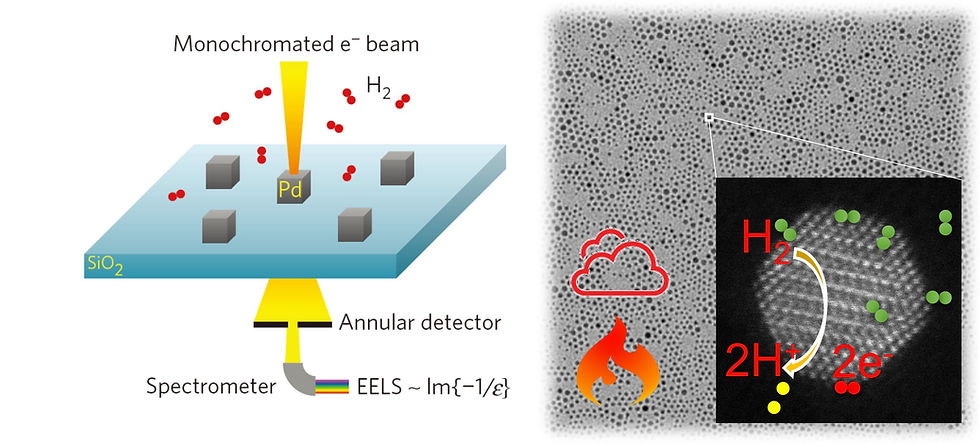
Hydrogen, the lightest atom in the periodic table, is one of the most important elements in energy technology. Within the solubility limit of host FCC metals, hydrogen atoms are able to occupy the octahedral sites. However, it is difficult to image such interstitial hydrogen atoms by TEM due to the weak interaction between the incident electron with the nucleus. We undertake the imaging of hydrogen atoms dissolved in the crystalline lattice by using electron ptychography phase contrast imaging and EELS with monochromated electron beam under hydrogen atmosphere inside TEM.
Imaging Migrating Oxygen in Operating Solid-Oxide Fuel Cells
Developing high energy efficiency solid oxide fuel cell (SOFC) require understanding oxygen transport mechanism in electrode and electrolyte during operation. Using real-time observation, visualizing migration oxygen in operating SOFC at medium temperature become possible. Revealing oxygen diffusion pathway shed light on the developing SOFC toward low temperature for high efficiency.
